
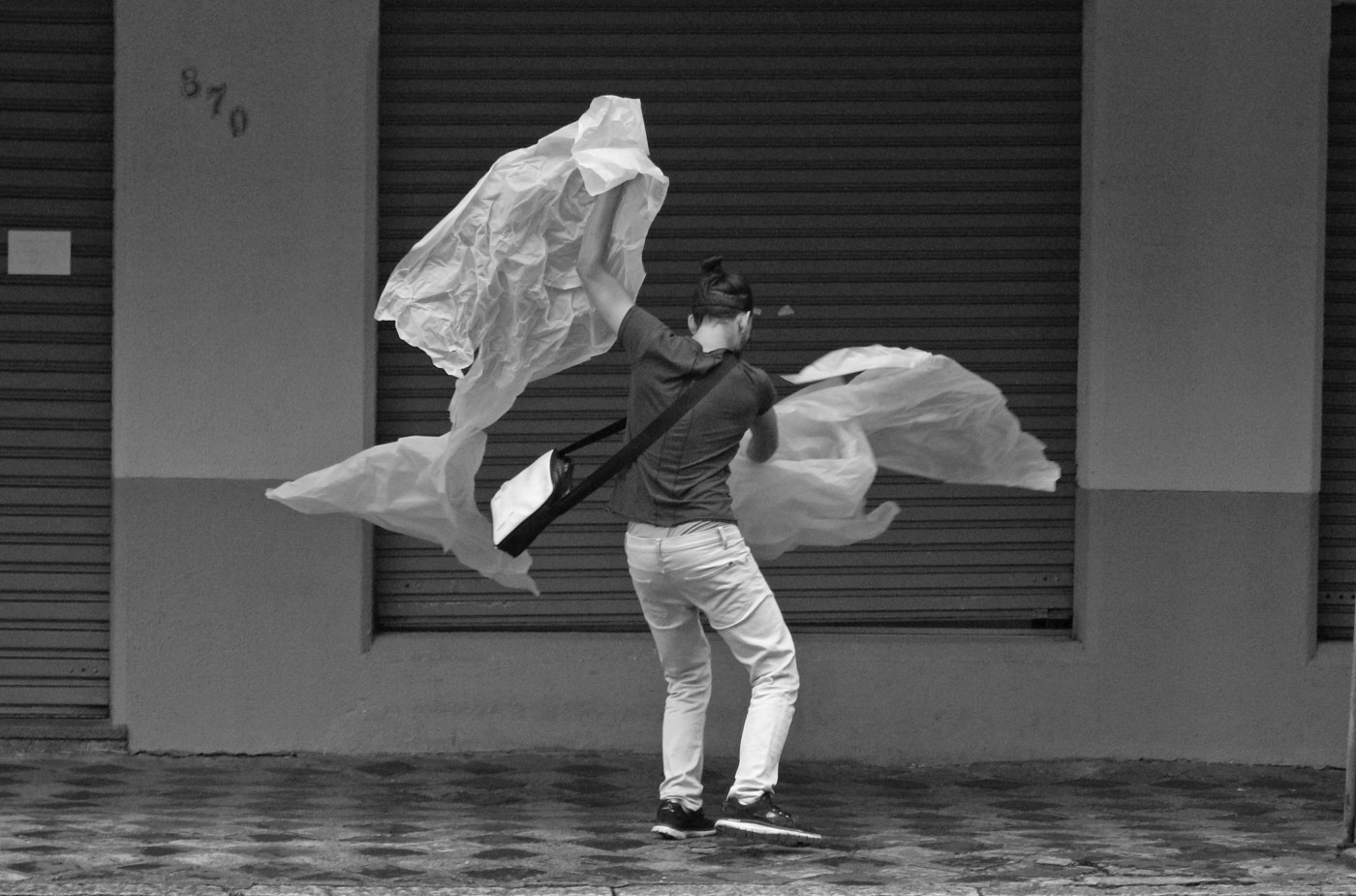
[English below]
Obra em Progresso é um projeto multimídia que investiga a noção de Origem na obra literária Finnegans Wake (1937), do irlandês James Joyce, e explora suas potencialidades na cena. Neste livro, reconhecemos a sugestão de que toda materialidade sempre se apresenta como representação. Ainda que atualizada em nossos corpos e experiências, ela é decodificada por milênios de linguagem e cultura, o que torna impraticável uma percepção sem seus filtros.
Assim, uma “versão original” permanece um mistério — não se apreende uma realidade “pura” ao nosso redor. Mesmo que imaginemos que tal experiência tenha sido possível aos nossos antepassados mais antigos, não conseguimos compreender nossas origens sem submetê-las às estruturas de um olhar moldado pelo nosso tempo.
Portanto, nossa experiência é “ausente de origem” em dois sentidos. Por um lado, isso se expressa na matéria: mesmo que envolvida por camadas de significados construídos por eras, ela resiste à dominação do sentido. A matéria é escura. Visível e palpável, não existe para os nossos sentidos desprovida dos véus da codificação cultural.
Mas a ausência de origem tem também uma definição histórica: quanto mais escrutinamos os estratos da História, mais associações produzimos entre suas partes e seus efeitos. Os enquadramentos não cessam de se modificar e as narrativas de prováveis origens se proliferam.
Nenhuma base de apreensão nos é possível. Nenhuma origem.
Somos seres históricos. Tentamos apreender o presente, e ele nos lança ao passado. Tentamos apreender o passado, e ele se modifica, atualizando-se no presente. E assim avançamos sem cessar, entre mutações que não encontram pontos de início. Somos, desde sempre, “em movimento”.
No livro de Joyce, além de tema, esta ausência de origem se torna forma. Camadas de narrativas se permitem ler simultaneamente, e nenhum tipo de base se sustenta, já que até mesmo a palavra é modificada para evitar correspondências diretas de sentido. Renuncia-se à linearidade em benefício da livre associação de vocábulos e narrativas e, incrivelmente, a leitura acontece. Sem começo e sem fim, num movimento espiral contínuo, ela acontece.
Refletindo sobre os procedimentos da obra de Joyce, perguntamo-nos o que significa uma ausência de origem em tantos níveis diversos na cena, já que esta lida diretamente com a matéria. Como enfatizar que a materialidade do tempo e do espaço não está dada, mas é filtrada por sentidos semânticos e por camadas históricas? Como tornar seu processo de apreensão uma “leitura” de livre associação entre esses extratos?
O processo investigativo ocorreu tanto na teoria — por meio do doutoramento em Artes Cênicas da artista Ana de Ferro, condutora do projeto — quanto na prática. Inspirados pelo próprio Wake, que, ao longo de seus dezessete anos de escrita, publicou trechos provisórios sob o nome Work in Progress, demos início a um projeto multimídia que investiga a noção de Origem em Finnegans Wake, intitulado Obra em Progresso.
Suas performances constituem fragmentos de um mesmo objeto artístico, bem como estudos para uma construção final. Assim, elas podem ser apreciadas de modo autônomo, mas são também experimentos que serviram à construção de uma obra que responde mais amplamente aos anseios da pesquisa: o espetáculo Embalada.
A seguir, narramos um pouco deste percurso.
STREAMING
Uma origem incerta pode ser vista tanto como um dos principais temas do Finnegans Wake, quanto como algo que se expressa em sua forma. Sua escrita espiralada não define a primeira palavra da primeira página como um início irrefutável de suas narrativas, e seus neologismos multilíngues tornam obsessivos os processos de busca pelos termos que participam da construção dos novos vocábulos. Até mesmo as publicações constantemente revisadas de seus capítulos, que resultaram em um livro de comentários críticos sobre a obra mesmo antes de ela estar pronta, sugerem um nascimento impreciso do romance, que já integrava o imaginário do cenário literário europeu antes da data que se tornou oficial. Interessava-nos também que não houvesse uma delimitação para a origem de nosso projeto. Era necessário começar sem começo. “The boarder incident prerepeated itself” (FW 81.32-33) [o incidente dos limites prerrepetiu-se].
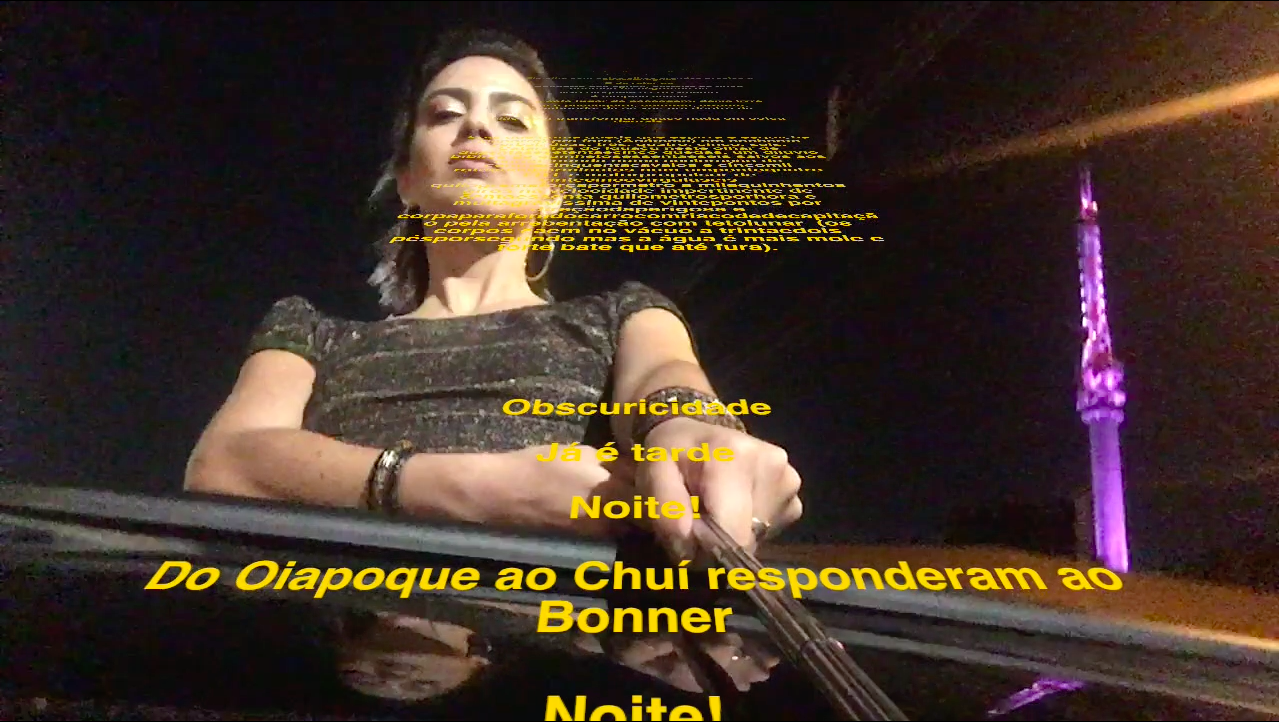
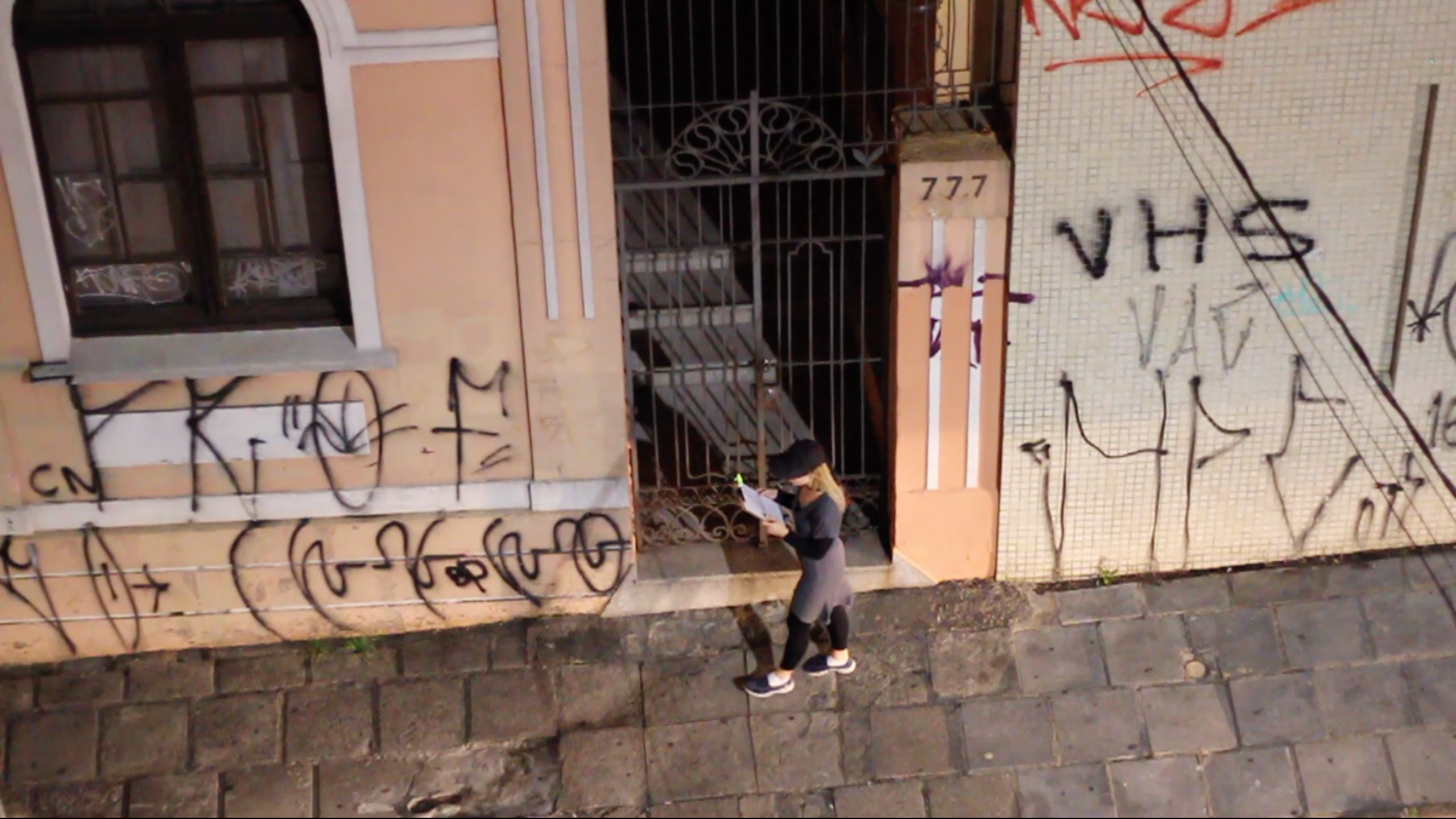
Assim, surgiu Streaming (2017), uma performance virtual veiculada pelo Facebook. No teto solar de um carro em movimento, Ana de Ferro se exibia para uma câmera segurada por ela mesma, enquanto um texto repleto de trocadilhos (ao modo wakeano) subia pela tela. Iniciar um trabalho teatral sem que de fato as pessoas estivessem presentes pareceu um modo de principiar um encontro sem de fato dar princípio ao mesmo — uma noção certamente transformada no mundo pós-pandêmico das lives de espetáculos.
A dramaturgia do fragmento assumia uma lógica de prólogo, apresentando a obra e a artista. Dessas duas, à semelhança do Wake, originava-se um discurso sobre feminilidade e aquilo que flui sem ser retido. Associavam-se referências ao rio, ao curso de carros que ali se via, bem como às próprias palavras, que corriam sobre a imagem com relativa concatenação de ideias, mas jorrando alusões em alta velocidade.
Tal excesso de informação sobrepunha-se ao exibicionismo superficial da performer: enquanto ela mantinha uma atitude típica das “selfies”, o texto adicionava novos sentidos — e, quiçá, ações — ao quase nada que se passava (o “quase nada” padrão das redes sociais). Os vocábulos se intensificavam em ritmo e alusões ao ponto da vertigem, e o “tão pouco” logo se tornava “coisa demais”.
A performance foi deletada logo depois de exibida, apontando para a efemeridade própria à teatralidade e deixando espaço para os encontros que viriam a seguir. Ela foi realizada no âmbito de uma residência artística de seis meses na Airez Galeria, em Curitiba, contexto no qual também se desenvolveram as próximas duas.
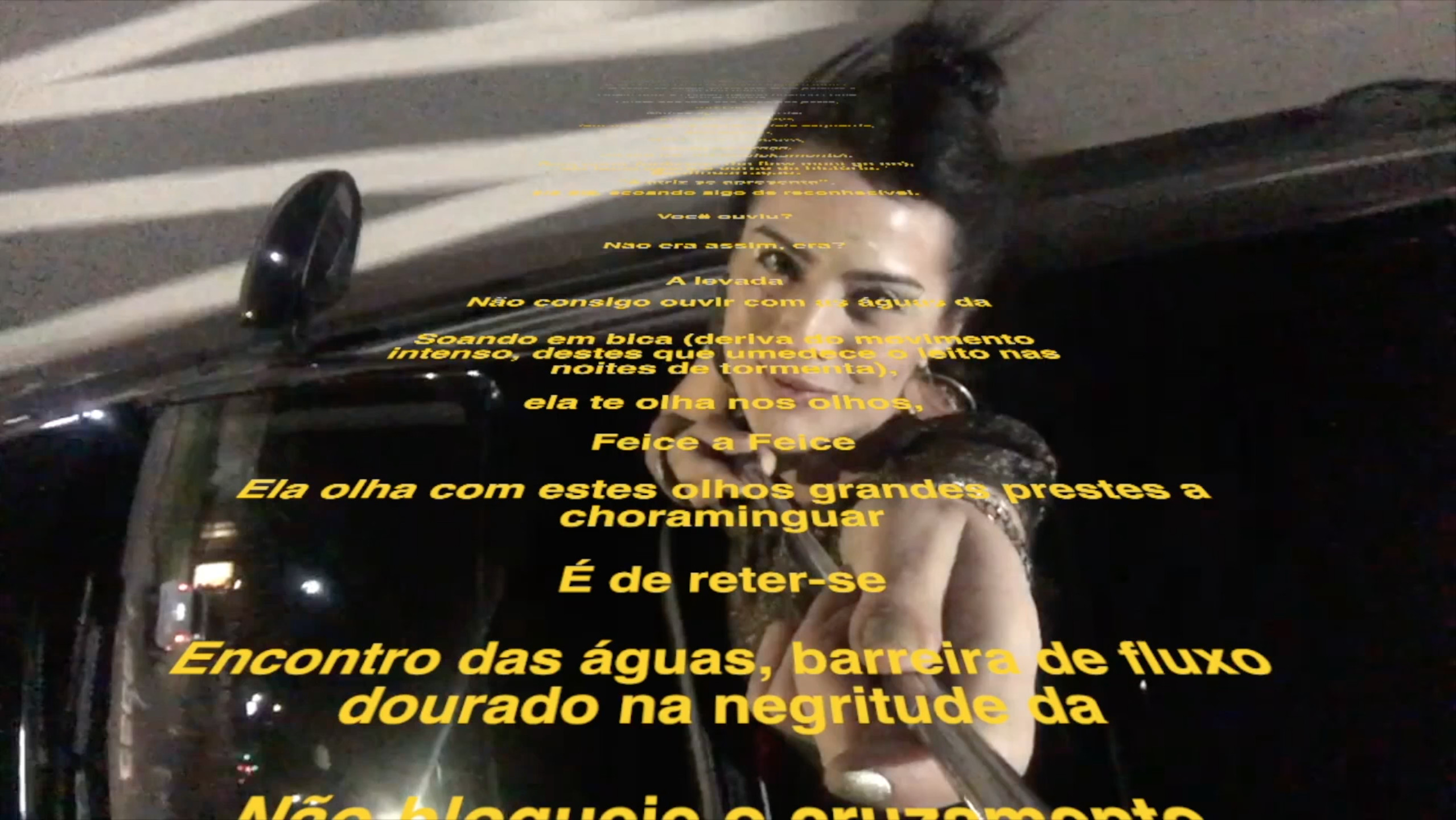
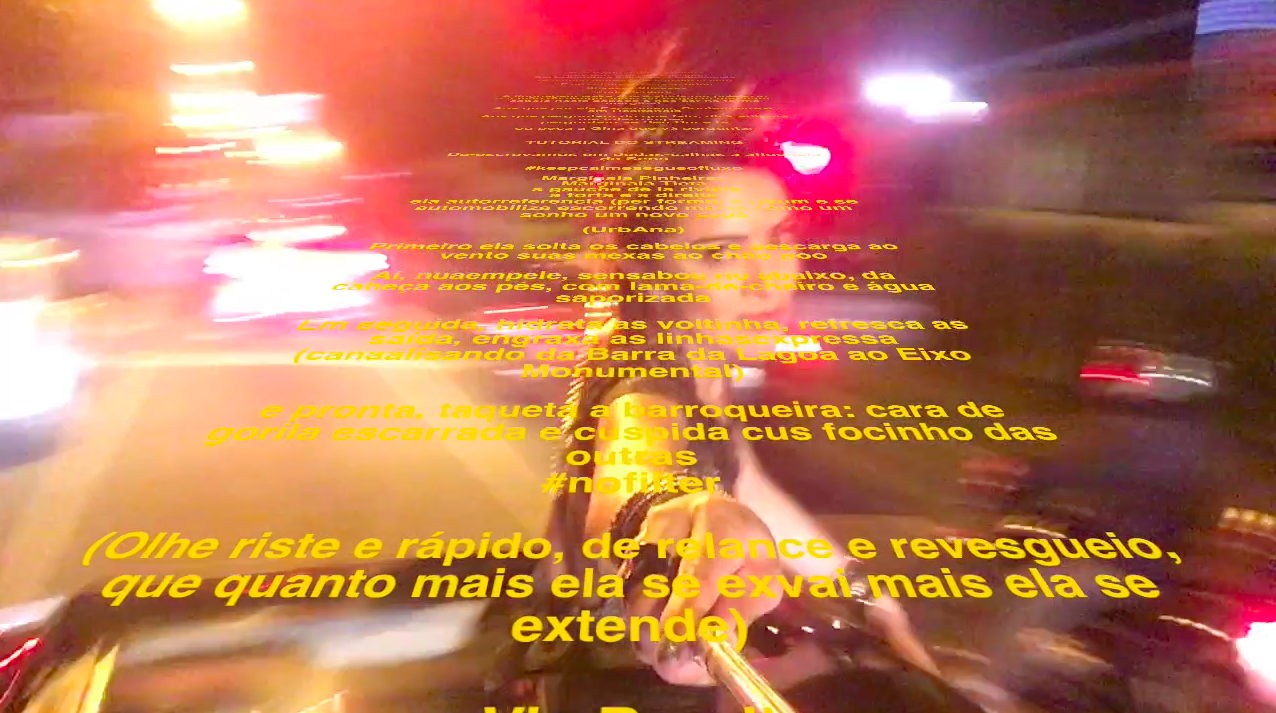
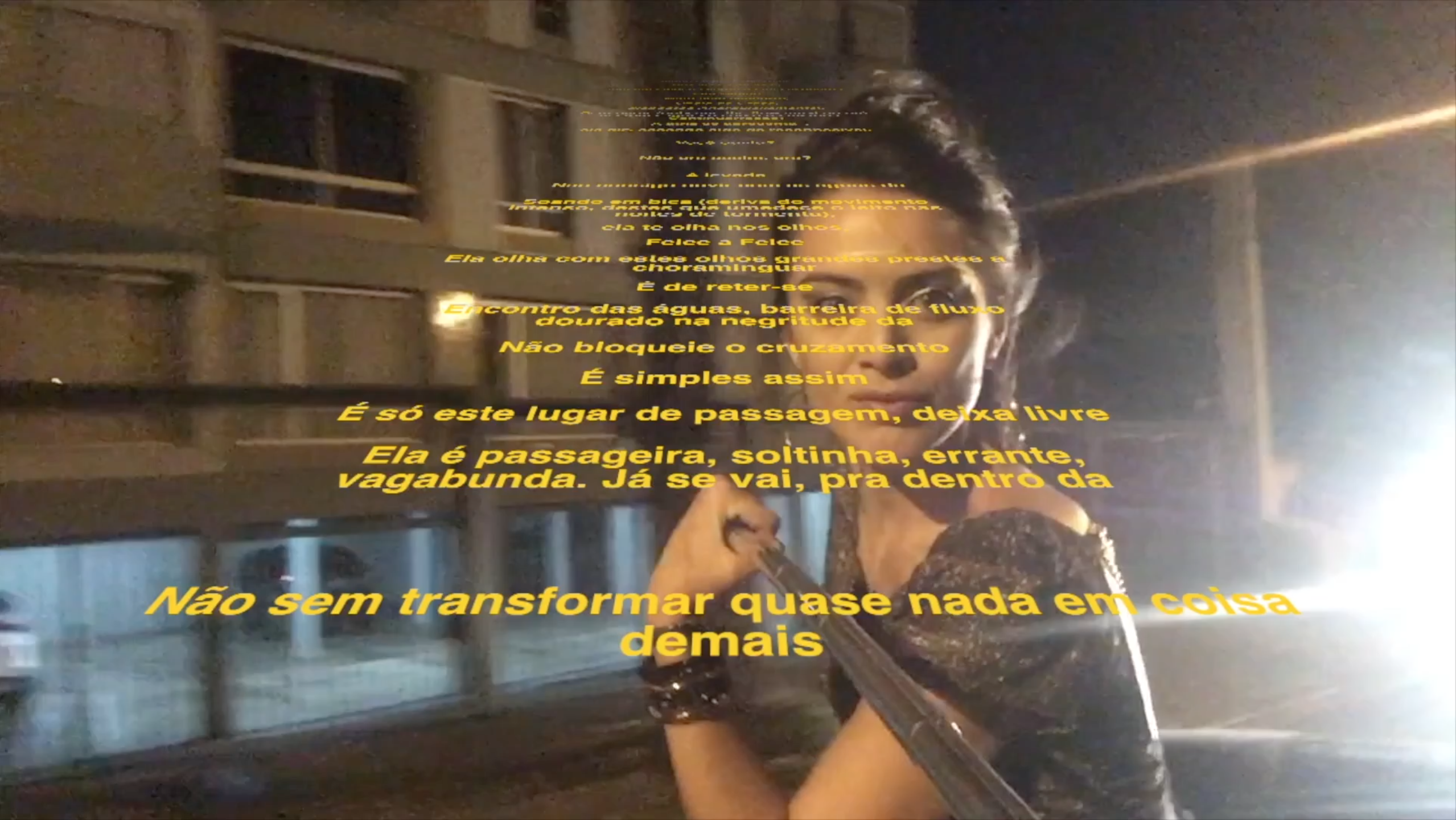
Concepção, roteiro e texto: Ana de Ferro
Direção e performance: Ana de Ferro.
Colaboração criativa e arte gráfica: Guilherme Zawa.
Apoio técnico: Daniel Starck, Leonardo Gnoatto e Guilherme Zawa.
Produção: Ana de Ferro.
Realização: Agora Coletivo e Airez Galeria.
SOBREPOSIÇÃO
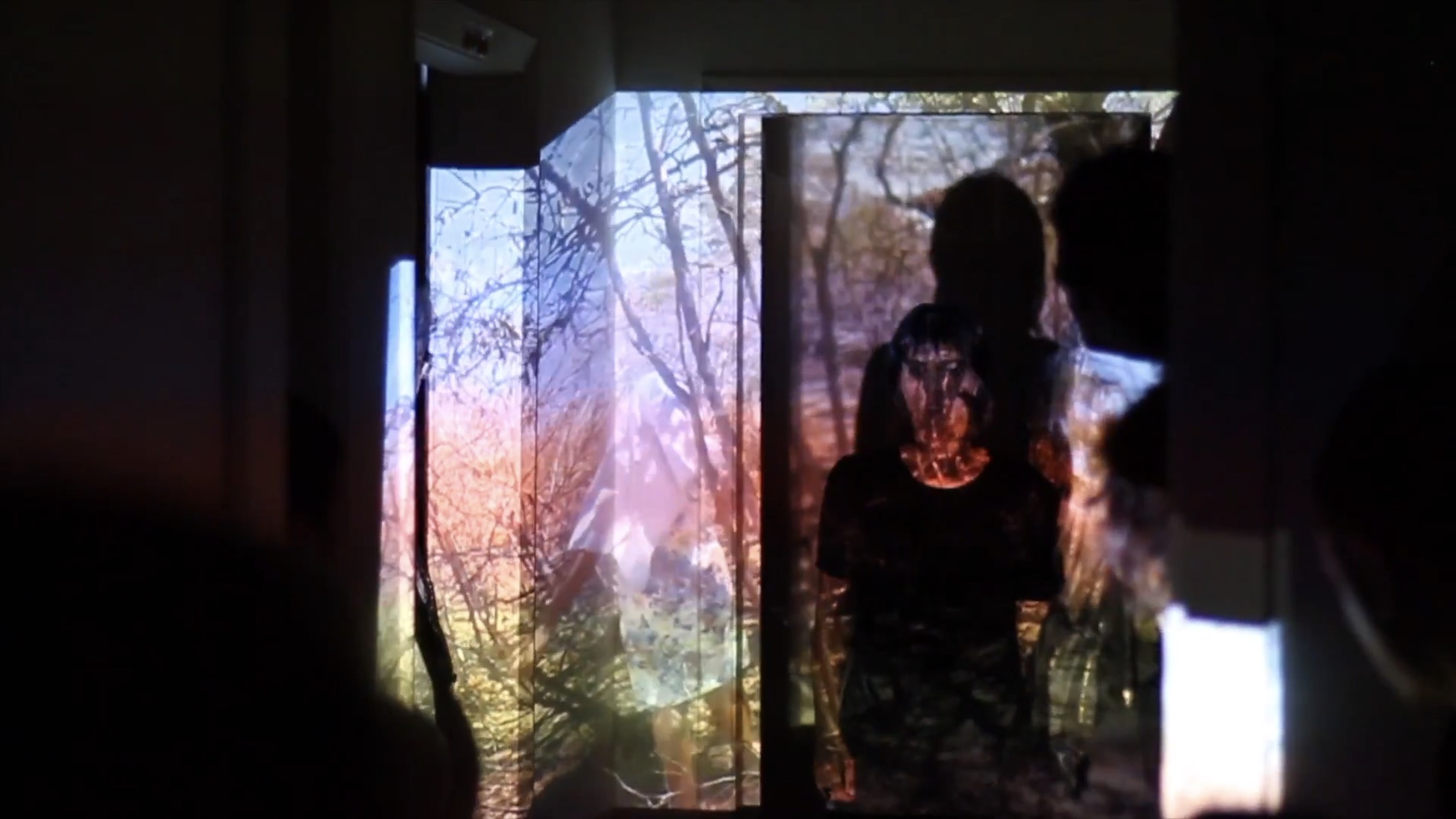
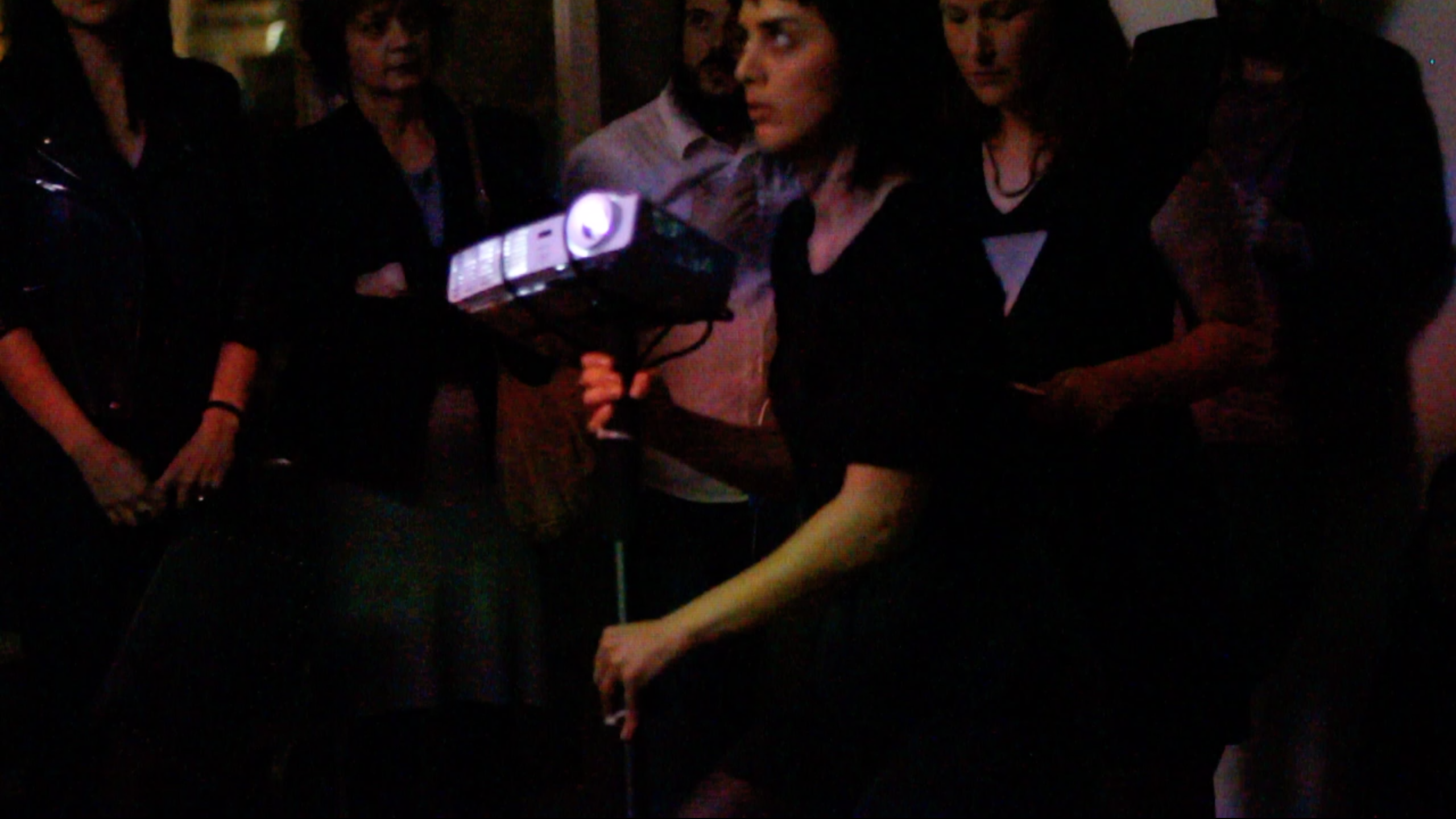
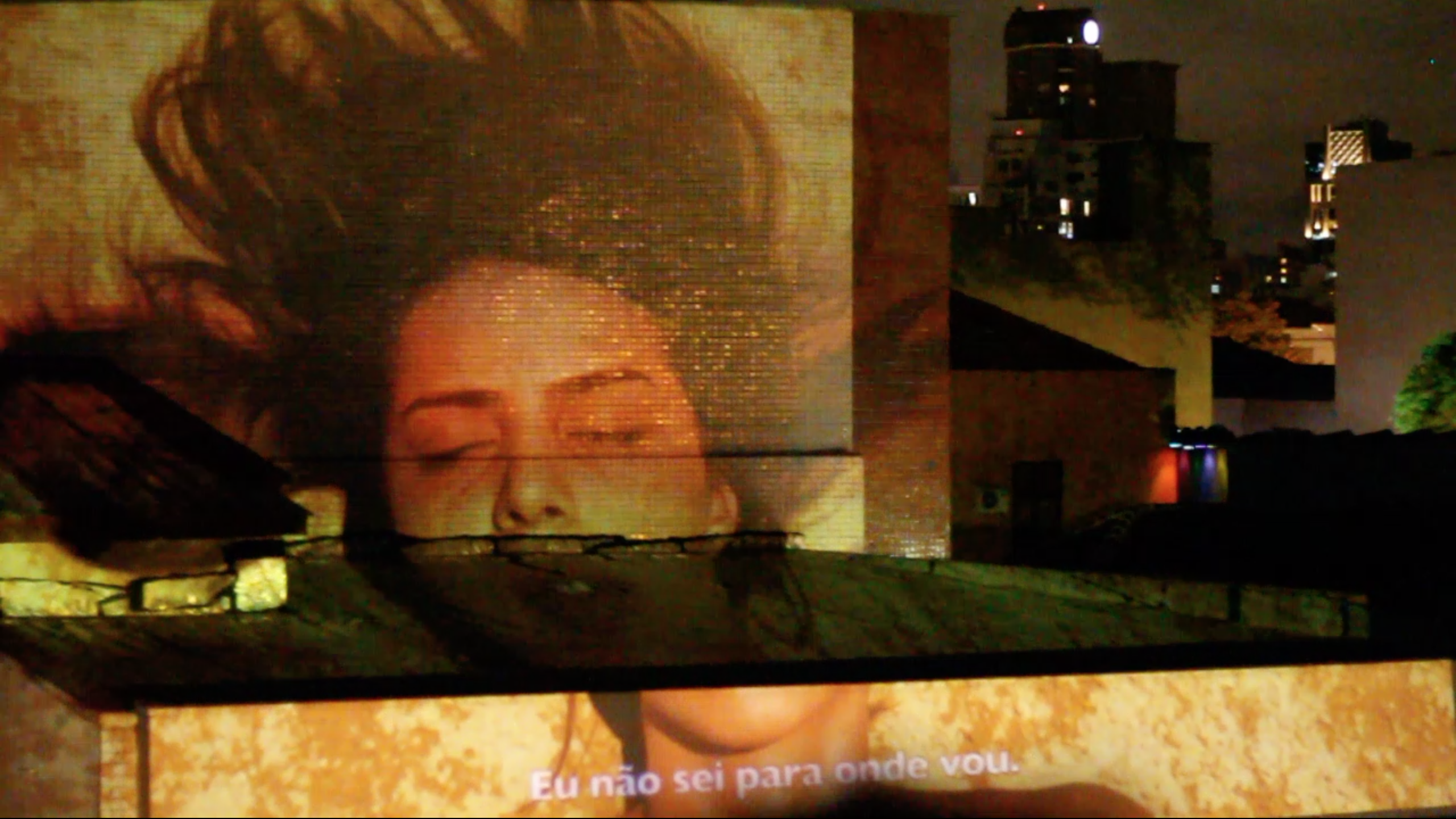
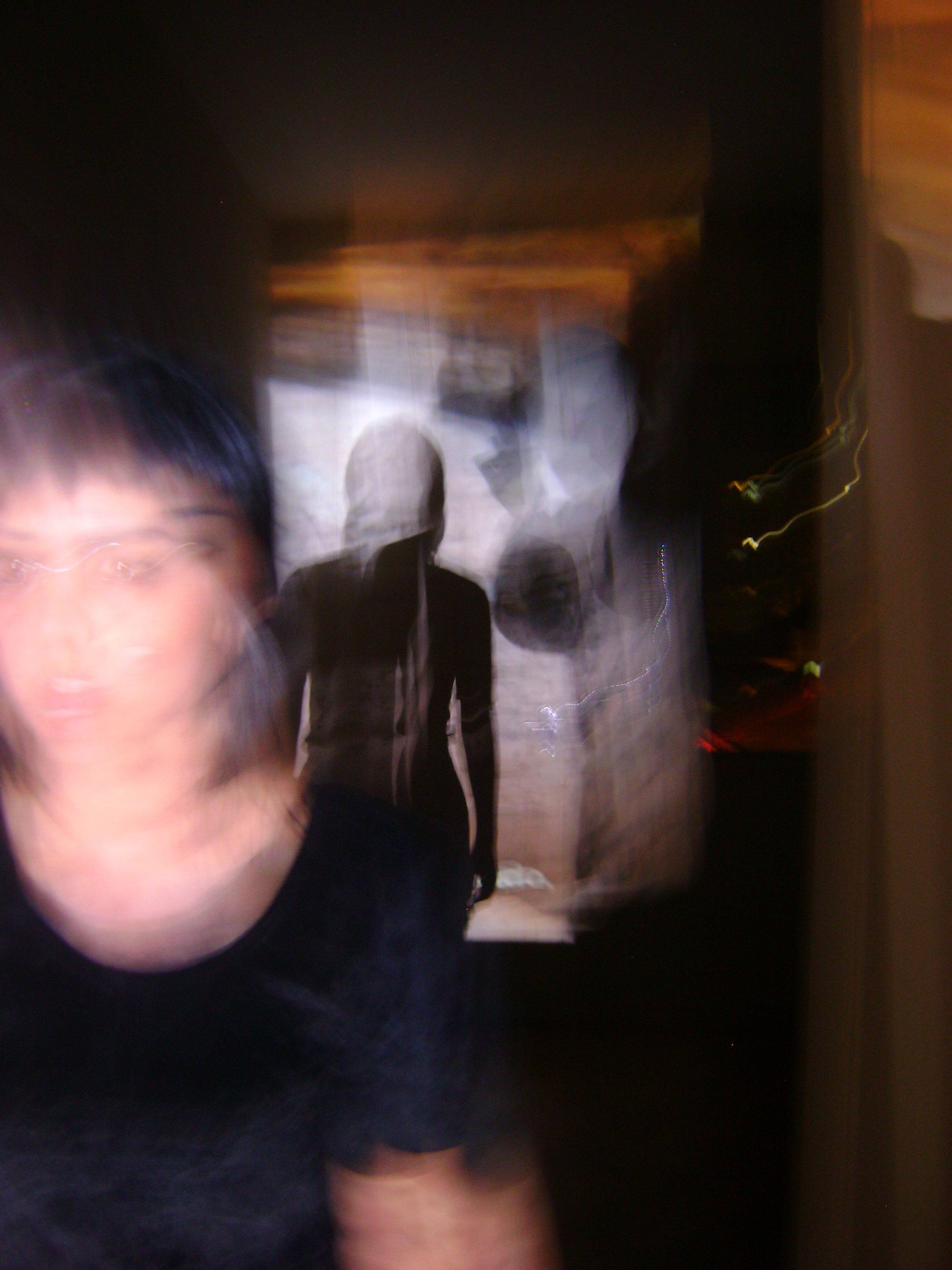
Sobreposição (2017) se duplicou a partir da primeira por relações de oposição. O ambiente passava do externo ao interno: as salas escuras da galeria, onde os corpos eram pouco visíveis. Se, na performance anterior, Ana de Ferro filmava a si mesma (no modo selfie comum às mídias sociais), agora ela exibia um vídeo manipulando um projetor pelo espaço. A presença de seu corpo por trás do objeto e a dança que com ele realizava pelo local tornavam a materialidade da imagem projetada um dado relevante.
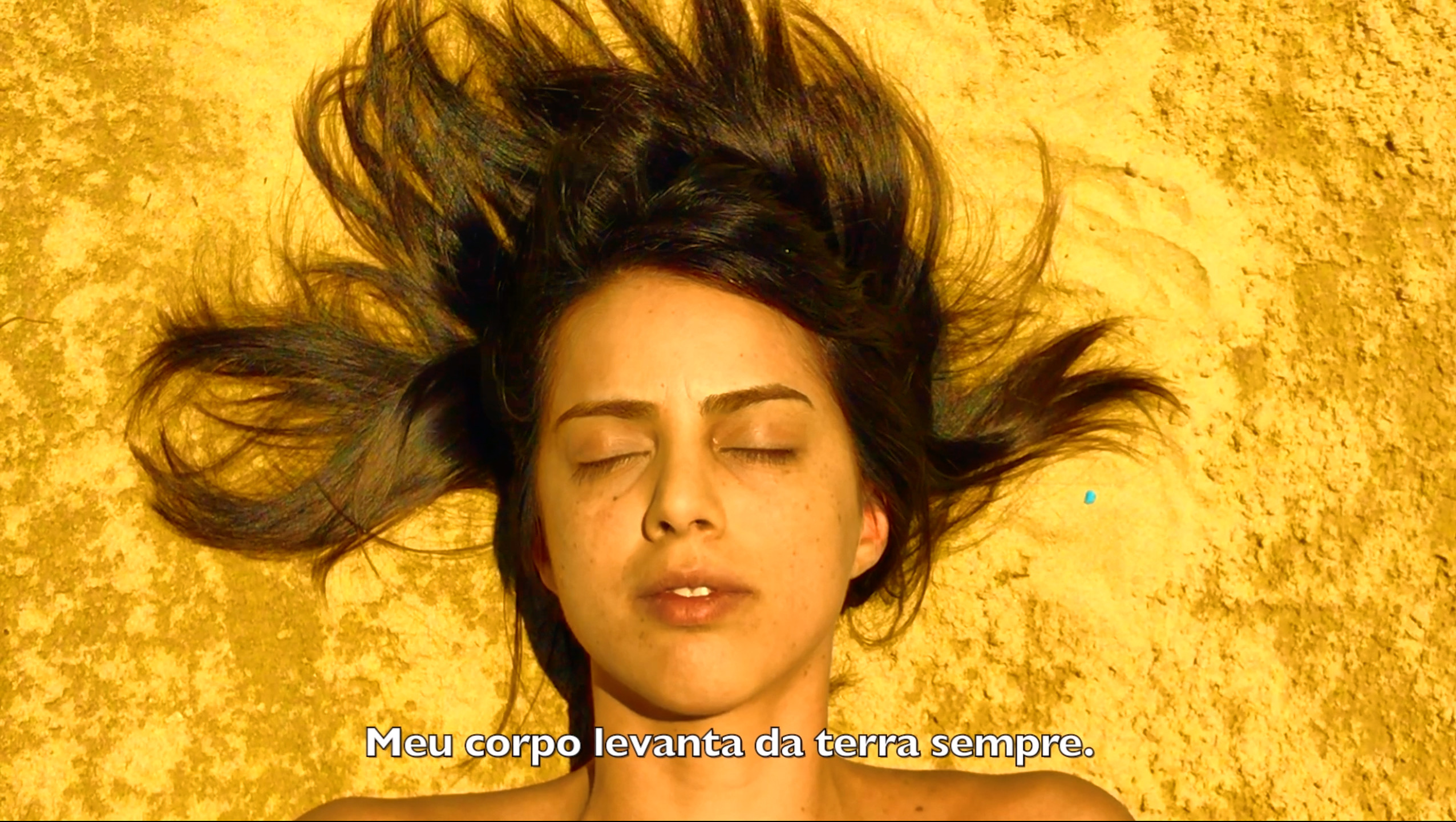
A cidade era novamente tematizada, mas, agora, pelas relações de pertencimento a algum território exploradas pelo filme mostrado. A performer, que em Streaming era referida pelo texto como “a atriz” e que dançava seu próprio exibicionismo vazio, agora expunha-se em outros níveis, revelando parte de sua própria história. Mais que isso: tratava-se de sua origem perdida e, supostamente, reencontrada. As legendas do vídeo contavam que ela havia feito aquelas imagens em uma visita ao sertão do Piauí para conhecer a terra de seus avós, que migraram para o sul, e os familiares que lá viviam. Explicavam que ela filmou horas de diálogos em que eles faziam relatos sobre aqueles locais, tudo para descobrir mais tarde que a captação do áudio não foi feita.
A partir dessa falha técnica, que gerava uma nova falha em sua biografia, a projeção reconstruía falas (que continuavam mudas) sobrepondo legendas às imagens. Algumas delas eram reais, frutos da memória. Outras, inventadas: trechos diversos do Finnegans Wake, traduzidos pela própria artista (embora isso não fosse dito explicitamente). Eles se referiam à terra como elemento natural e como território, bem como falavam em “escavar” como descobrir as camadas de repetição de estruturas históricas. Gravuras rupestres da Serra da Capivara, parque arqueológico localizado na mesma região em que mora a família da artista e que hoje marcam o espaço conhecido como “o berço do homem americano”, insinuavam um nível anterior de registro cujo sentido nos escapa. “A phantom city” (FW 264.19) [uma cidade fantasma].
Ao invés do fluxo de consciência que conduzia o experimento anterior, a narrativa de Sobreposição era estruturada por repetições que estabeleciam contínuas ressignificações poéticas, criando camadas e versões. Nessas variações sobre o mesmo tema, atrizes entravam em cena interpretando a autora no modo em que essa aparecia no vídeo. “frequently altered its ego with the possing of the showers (Not original!)” (FW 51.02-3) [frequentemente seu ego alternava com a posse das exibidoras (Nada original!)].
Aos poucos, elas iam contaminando a dramaturgia com as suas próprias biografias, também repletas de migrações e de pertencimentos incertos. Ao final, a ação ia para fora: o vídeo era projetado nas paredes de prédios da cidade, sobrepondo outras terras (o Piauí, que aparecia nas imagens, mas também as das atrizes, que iam entrando no texto da legenda) àquela de Curitiba. “in the land of the space of today” (FW 169.07) [na terra do espaço do hoje]. Repetia-se, assim, o ato da gravar na pedra, como aquele das representações pré-históricas referidas.
A legenda que se repetia obsessivamente tentava compreender, dominar, estabilizar sentidos e territórios, mas aos poucos se modificava, sofria uma contaminação inevitável do novo. Os limites entre territórios, sujeitos emissores e o próprio texto wakeano alteravam-se a todo tempo e todos se insinuavam como partes da artista, “projeções” suas.
Concepção, roteiro e texto: Ana de ferro
Direção e performance: Ana de Ferro.
Atrizes convidadas: Kamila Demkova e Sau Bueno.
Colaboração criativa e arte gráfica: Guilherme Zawa.
Produção: Ana de Ferro.
Realização: Agora Coletivo e Airez Galeria.
CARTOGRAFIA
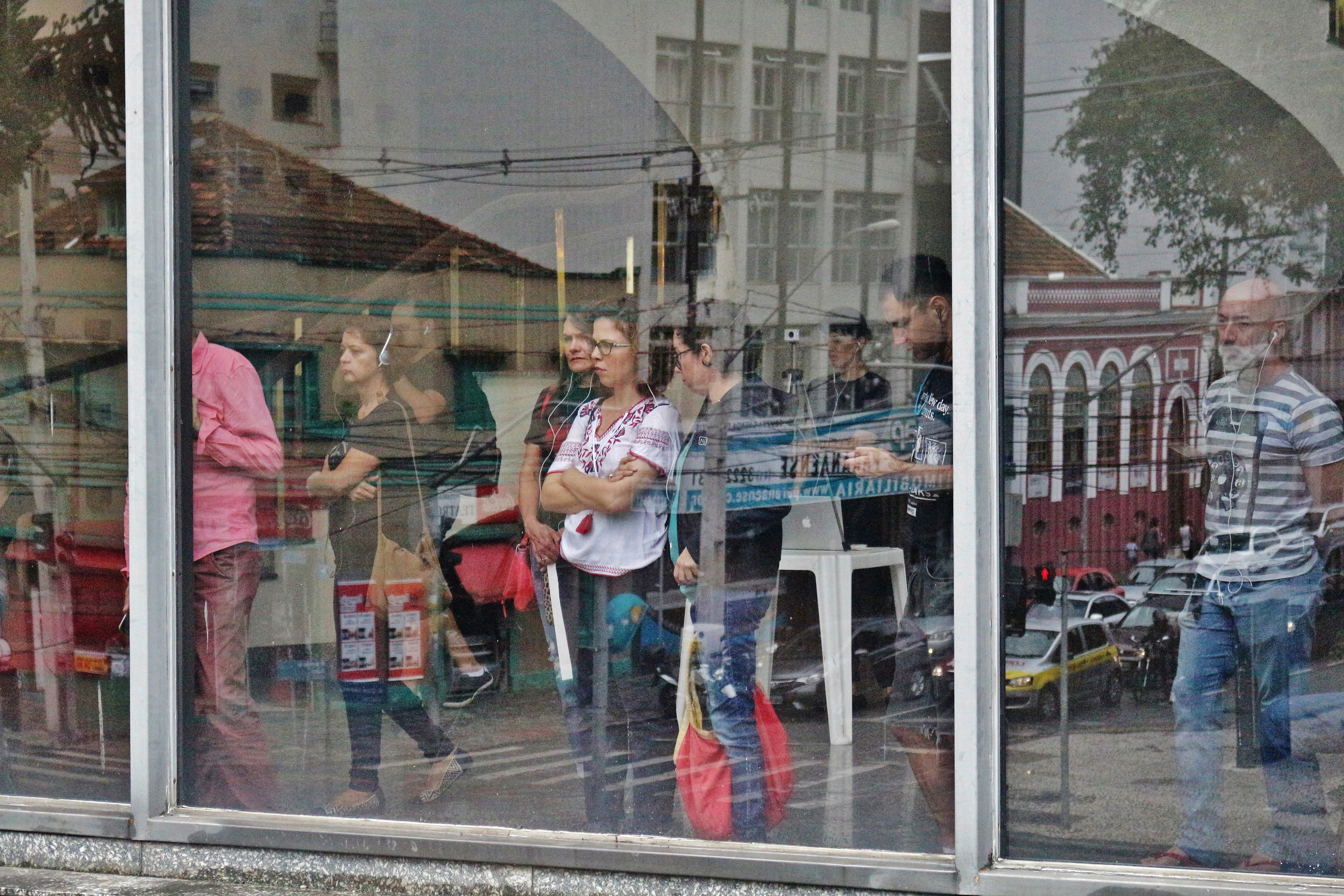
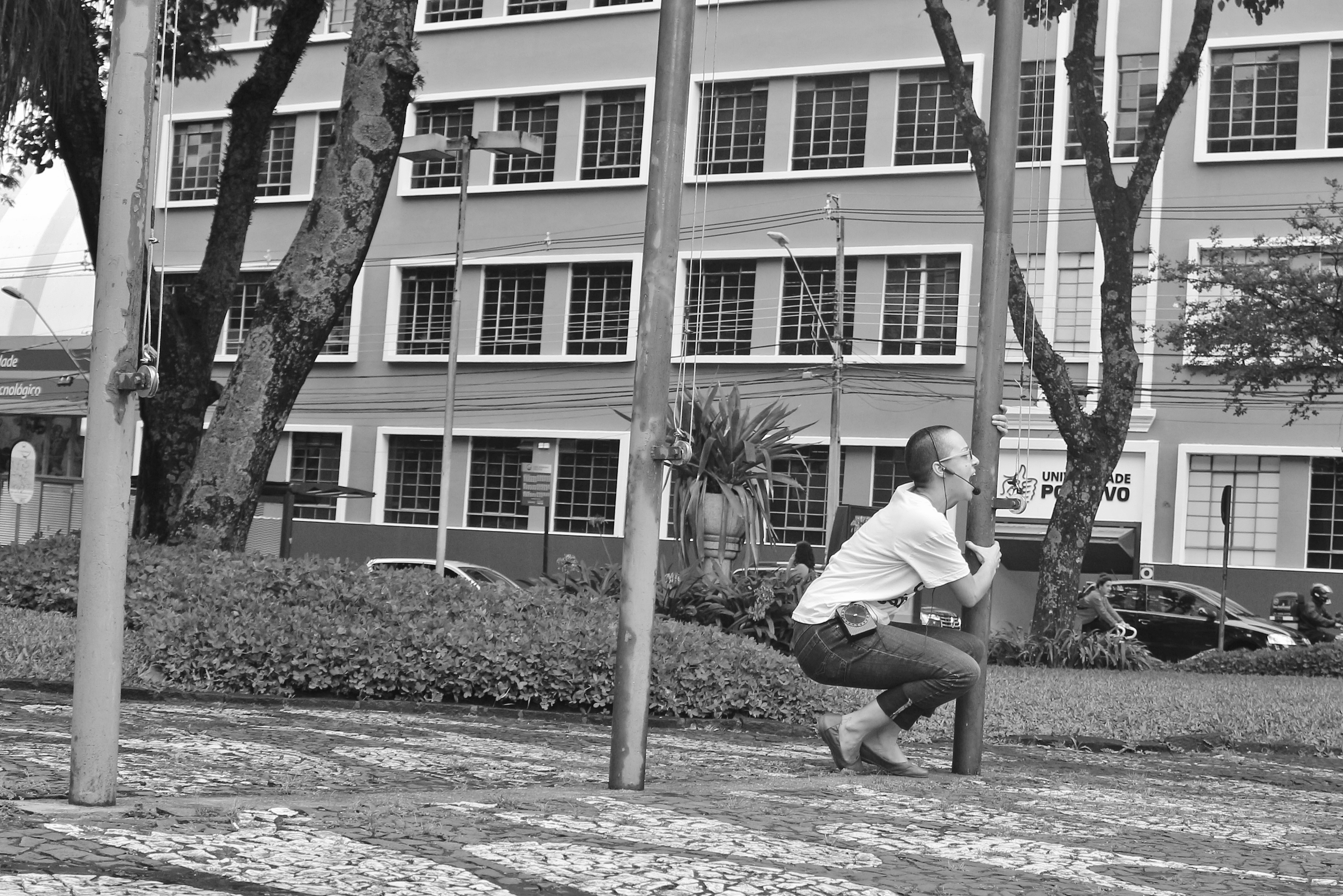
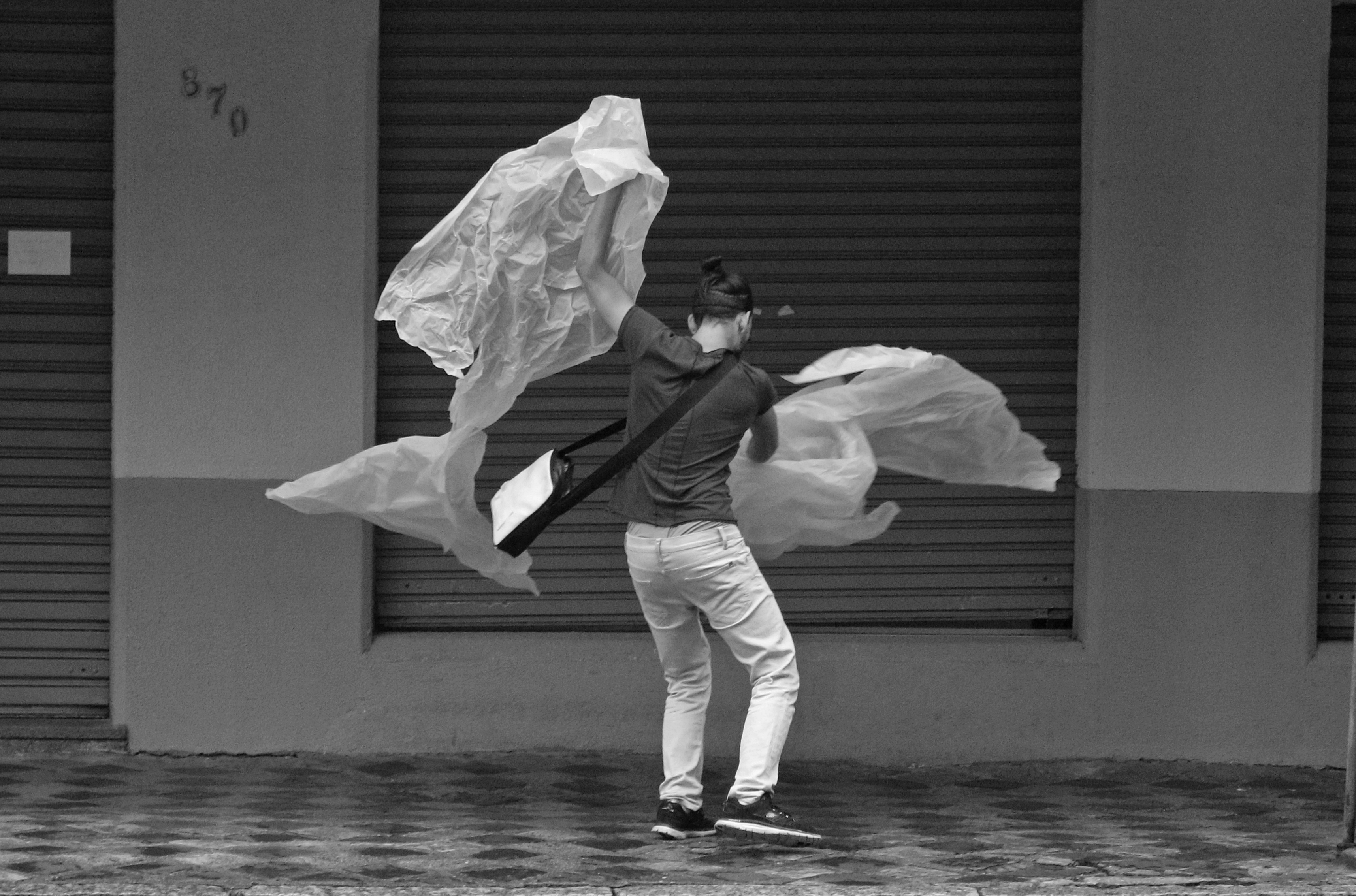
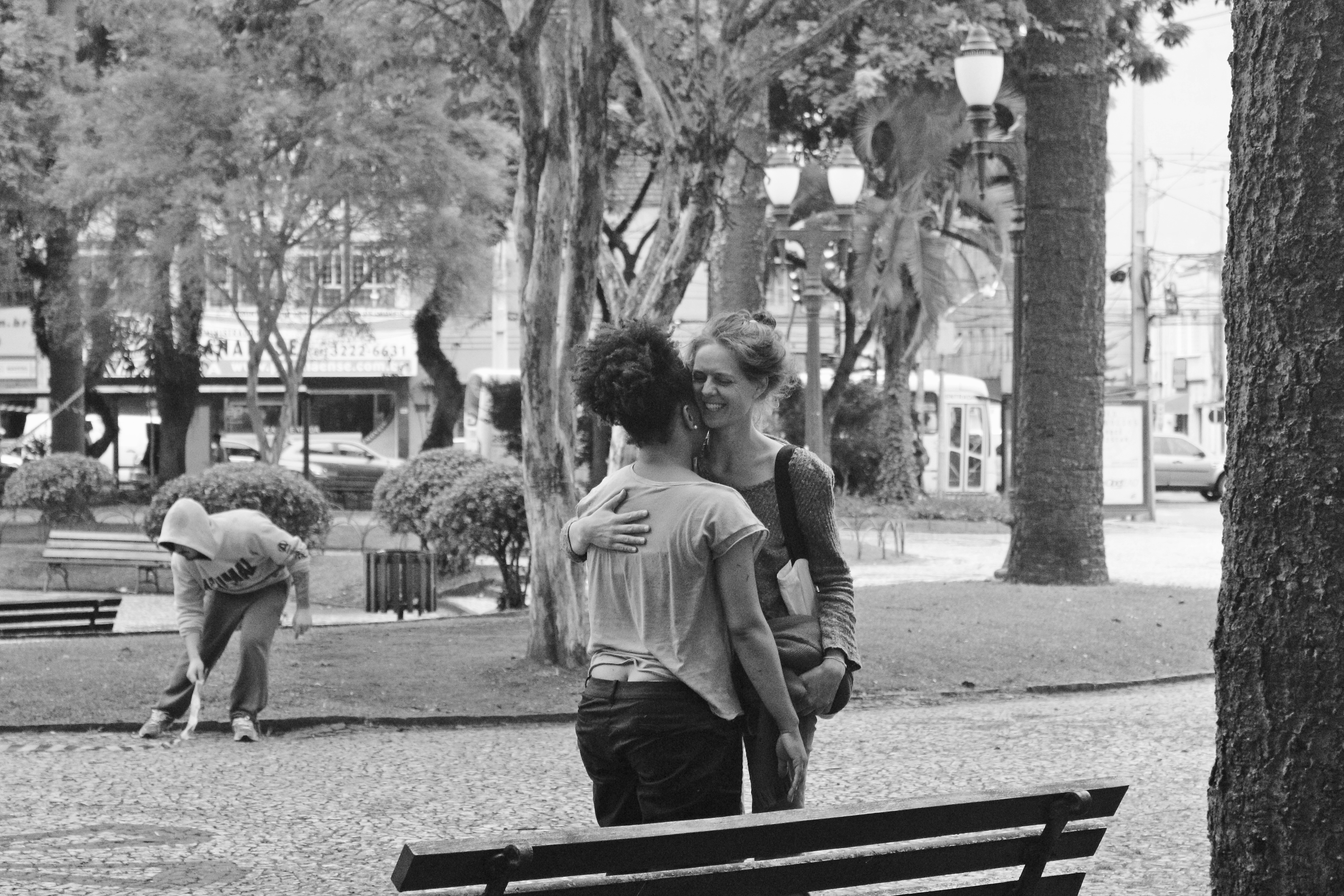
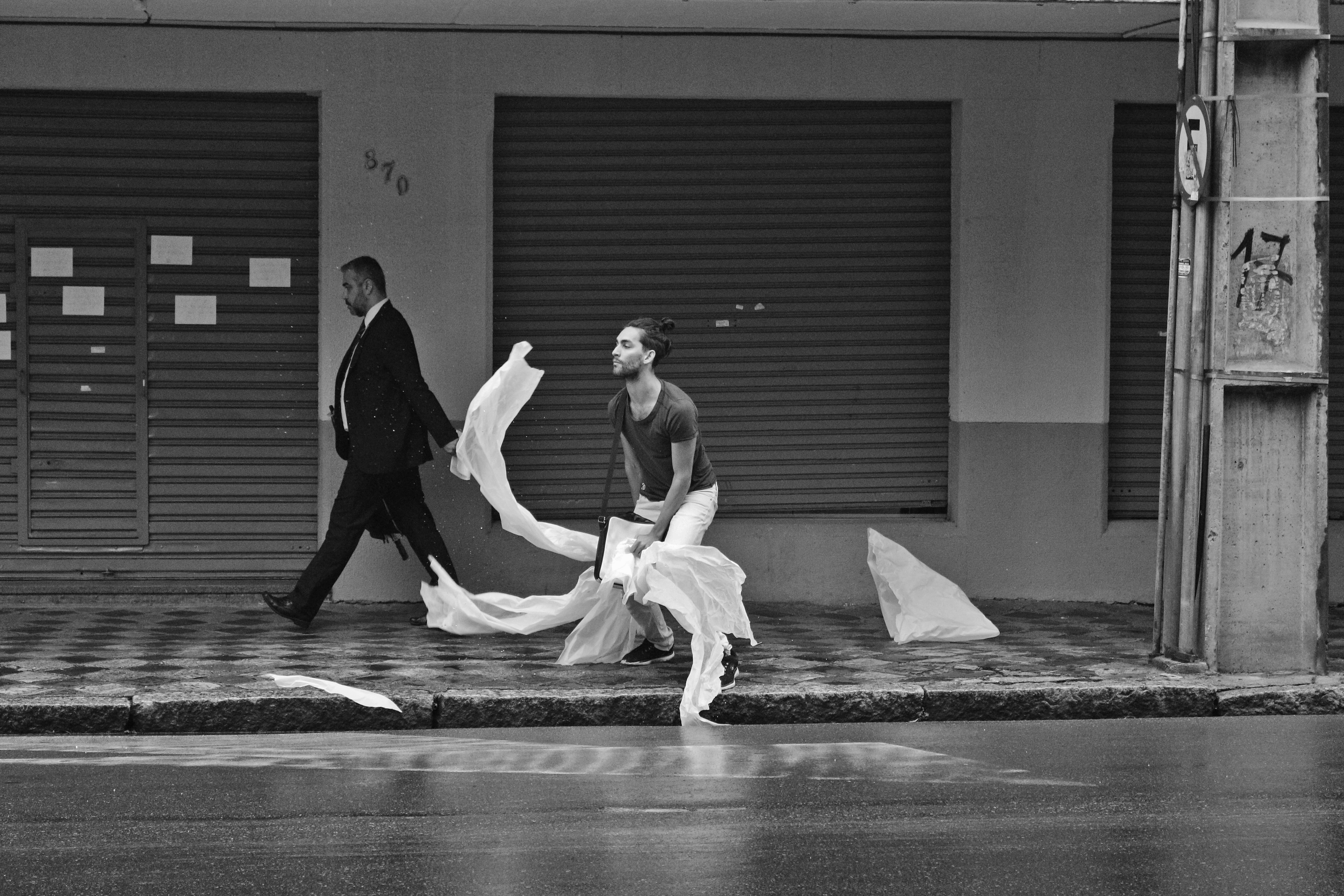
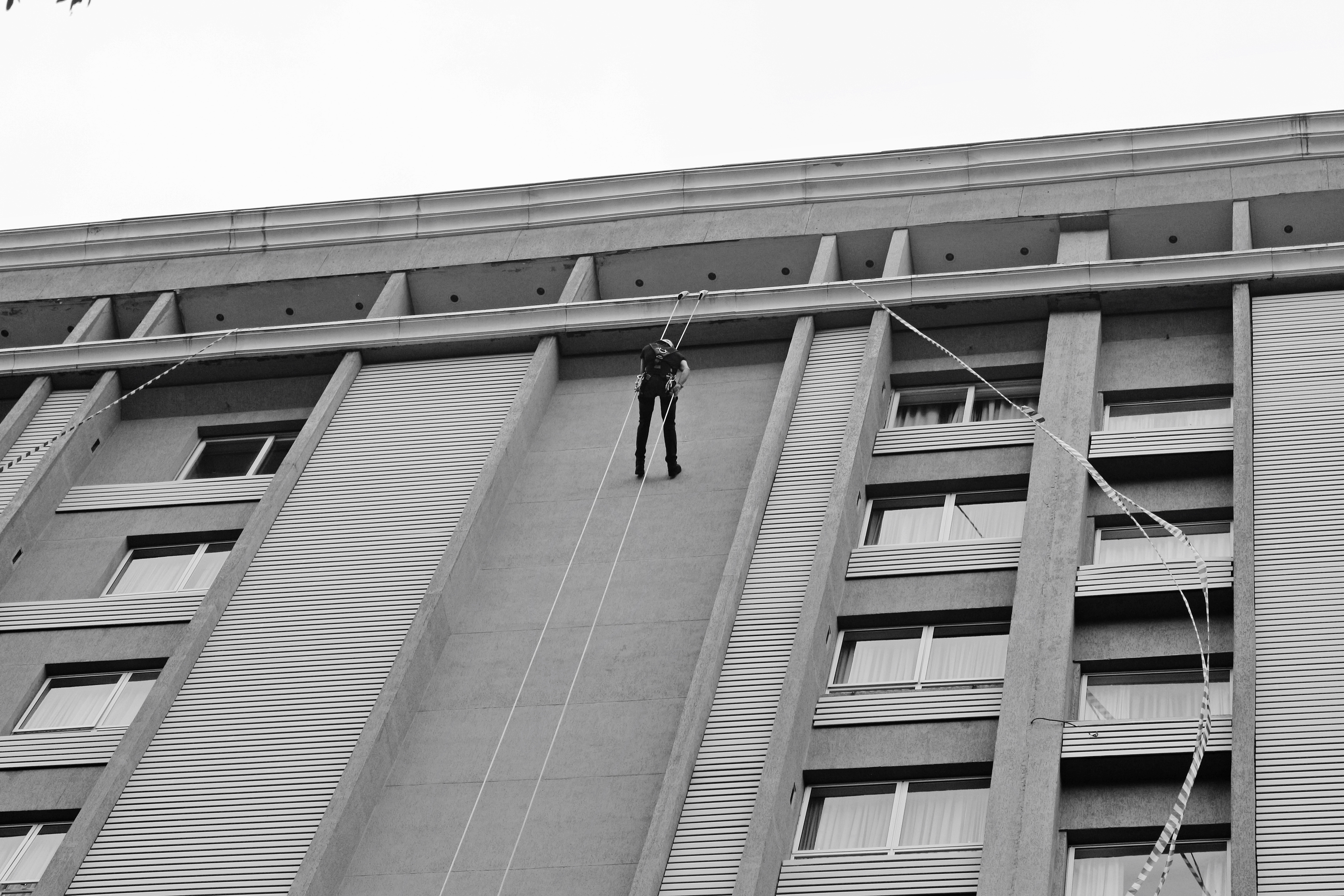
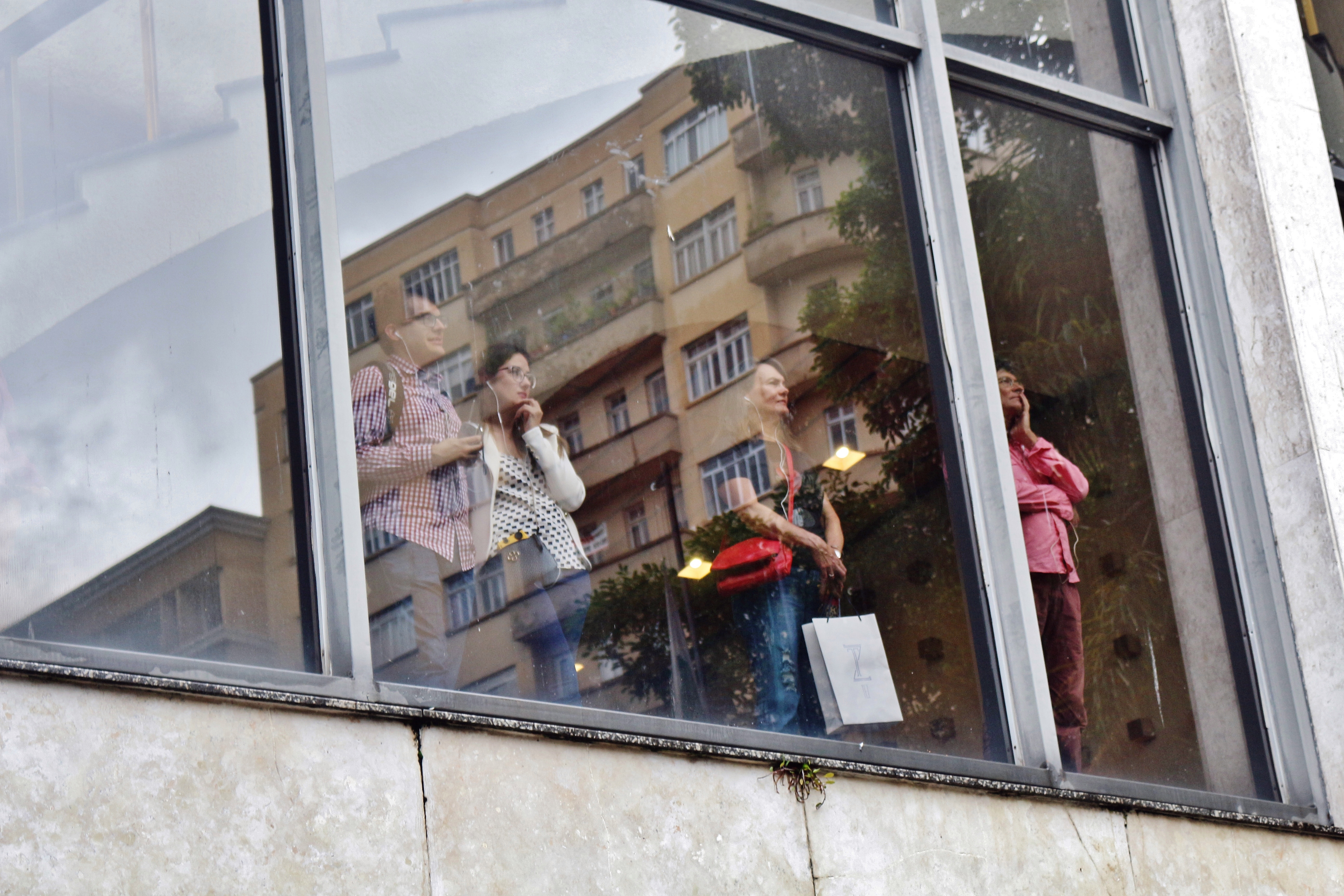
Cartografia (2018) aconteceu no âmbito da Bienal Internacional de Curitiba, no Circuito de Galerias. A ação foi realizada no saguão do maior auditório do Teatro Guaíra, altamente consagrado no Paraná, situado no centro da capital. Os espectadores assistiam à rua de dentro do local enquanto ouviam uma narração em fones de ouvido. Artistas infiltrados realizavam ações comuns no ambiente. Aos poucos, essas ações eram exacerbadas, de modo que eles se destacassem do restante das pessoas em movimento. Logo, mergulhavam no fluxo indistinto novamente e “desapareciam” em sua normatização, fazendo a observação oscilar entre a roteirização própria ao meio urbano e aquela que nele se instalava e sobressaía, sobreposta como estranhamento.
Era relevante que ela se desse em um imponente ícone teatral, pois a narrativa provocava o debate sobre uma diferença verificável entre o teatro e o happening. As performances anteriores apareciam por meio da tematização da História como fluxo contínuo de estruturas repetitivas e do pertencimento a uma terra. Buscava-se apor a teatralidade histórica àquela do “real”.
“I will tell you all sorts of makeup things, strangerous. And show you to every simple storyplace we pass. […] That’ll be some kingly work in progress” (FW 625.05-14) [Vou te contar todo tipo de coisa inventada, estranha. E te mostrar a todo simples lugardehistória que passarmos. (…) Será uma obra em progresso Real].
As fronteiras identitárias e as determinações de origens eram sugeridas também nas noções (fragmentadas e instáveis) de identidade nacional, aludindo, por exemplo, à carta de Pero Vaz de Caminha, primeiro registro da origem da nação, e à carta de suicídio de Getúlio Vargas, marco de um de seus finais de ciclo. Ainda, alguns trechos wakeanos integravam esse mosaico.
Se a sobreposição era novamente uma ferramenta de fricção entre a produção artística e o real, a cena era mais dissolvida que a dos experimentos precedentes e sujeita à intervenção espontânea dos passantes. A narração, que explorava uma oralidade wakeana, não direcionava o olhar e sequer tratava diretamente do cenário, sendo possível fazer associações entre o que era dito e o que era visto com bastante liberdade. Em certo nível, era o próprio espectador que decidia o que do ambiente incluiria na obra. Seu próprio julgamento sobre como as coisas faziam sentido é que determinaria as imagens integrantes, seja por reconhecer intencionalidades por parte da artista, seja pela vontade de montar uma seleção própria de materiais entre tudo o que via.

Concepção, roteiro, texto e direção: Ana de Ferro
Edição de áudio: Ana de Ferro
Vozes: Ana de Ferro, Michele Pucci, Luiz Felipe Leprevost, Eduardo Ramos, Otávio Linhares, Daniel Starck e Renato Sbardeloto
Artistas no espaço público: Airton Rodrigues, Cláudia Regina, Eduardo Simões, Renato Sbardelotto e Thaís Menezes
RENATA DE NOVO
Nas três obras que compõem o período de residência na Airez, pode-se perceber algum tipo de dissolução da materialidade, um espalhamento dos indivíduos e dos espaços que compõem a obra e que é (res)significado pela palavra fragmentada, ao estilo wakeano. No entanto, o percurso demonstrou como a própria materialidade deste vocábulo reinventado era o que havia de mais potente para a cena. Ele era, em si, um acontecimento. Era uma rebeldia libertadora da linguagem que recriava o entorno.
Nos próximos anos, o processo de reflexão teórica se seguiu e o percurso de descobertas foi narrado em uma palestra-performance realizada no II Workshop in Progress (2021). Intitulada Renata de Novo, ela apresentava a pesquisa fazendo uso do próprio jogo entre oralidade e escrita ao qual se fazia referência.
O trabalho serviu de protótipo ao que, mais adiante, viria a ser a estrutura de Embalada. Ele testava – naquele momento, ainda no ambiente virtual – o que já se notava como grande possibilidade para a cena teatral: uma teatralidade da escrita.
A comunicação foi mais tarde publicada na revista Qorpus (UFSC). Como explicado ali, trata-se do registro do que é também uma fala e que, portanto, requisita a verificação da apresentação performoverbovocovisual, (mais tarde reencenada e tornada disponível no Youtube.
A operação cênica por nós desenvolvida como conclusão deste projeto avança a partir daquela proposta.
EMBALADA
Em Embalada, a materialidade cênica elege a escrita como linguagem dominante e enfatiza sua materialidade. Mas, uma vez que o código linguístico serve para apontar as coisas do mundo, confundem-se as noções de concretude.
O verbo se transforma em instrumento de construção do momento presente, oscilando entre descrever exatamente o que se passa no ambiente e “projetar” sobre ele um acontecimento que não se dá no plano material. O tempo presente é projetado por meio de uma palavra dupla, como a wakeana, e portanto associativa, plural, composta e compositora de justaposições.
Aqui, o polo impositivo que é o das ideias, aquele que tenta sempre dominar a matéria, o faz com um verbo desobediente, de modo que a suposta tentativa de controle envolve, de partida, uma rebeldia. Institui-se um agora que é incerto, ambivalente, conflito de possibilidades. Tudo é escorregadio. Tudo desliza. Falta o chão seguro.
O projeto está em busca de patrocínio para viabilizar sua montagem.
MAMAFESTA
Obra em Progresso é uma trabalho multimídia que já se iniciou em algum momento indeterminado e não tem planos para acabar.
Obra em Progresso é um work in progress. E quanto mais progride, mais se dissolve.
Obra em Progresso envolve diversos artistas, locais e objetos, todos com funções e identidades móveis e intercambiáveis.
Obra em Progresso compõe-se de diversos fragmentos a serem apreciados em conjunto na forma de um poliedro.
Obra em Progresso faz sentido.
Obra em Progresso convida você e todos os seus fragmentos a desvendar os seus sentidos.
Obra em Progresso narra suas narrativas e as narrativas que as geraram. As narrativas são sempre a mesma, mas ela nunca é igual.
Obra em Progresso é sempre dúbia e seus contrários se chocam e se amalgamam formando um alguém indivíduo.
Obra em Progresso é unidade, mas as partes de Obra em Progresso não cessam de se mover e mudar.
Obra em Progresso se apresenta como um caleidoscópio. As apresentações de Obra em Progresso fazem sentido.
Obra em Progresso uma vez apresentou um manifesto sobre si. Ele é conhecido por 111 nomes diferentes.
Obra em Progresso demanda paciência.
Obra em Progresso provoca desejo.
Obra em Progresso arranca risadas.
Obra em Progresso é obra da ignorância que implica a imitação que conecta conhecimento que forja a forma que solda o saber que converge contatos que suaviza a sensação que dirige o desejo que adere à anexação que mira a morte que vela a vida que envolve o enrolar da existencialidade.
Obra em Progresso é afeita a mitologias e todos os tipos de verdade.
Obra em Progresso converte católicos em protestantes e protestantes em católicos, palmeirenses em corintianos e corintianos em palmeirenses, sulistas em nortistas e nortistas em sulistas, esquerdistas em direitistas e direitistas em esquerdistas, atores em espectadores e espectadores em atores, tradutores em glossolálios e glossolálios em tradutores, água em vinho e vinho em água, saco em mala e mala em saco, Ana em Ana e Ana em Ana, .mp4 em .mkv e .mkv. em .mp4, em um vice-versa infinito. De modo que quando um alcança seu oposto deve opor a si mesmo novamente.
Obra em Progresso tem quatro direções e para achar seu norte basta se voltar aos ventos que sopram para o sul.
Obra em Progresso é um mapa. Esse mapa é uma carta. Essa carta é um livro. Esse livro é desenhado. Esse desenho é animado. Esse vídeo é uma performance. Essa performance é uma coreografia. Essa coreografia é urbana. Esse urbanismo é mapeado. Esse mapa é uma Obra em Progresso.
Obra em Progresso evita definições últimas. Este texto sobre Obra em Progresso ainda é uma obra em progresso. Você está progredindo bem nele.
Obra em Progresso é um golpe de dados: avance duas casas.
Obra em Progresso é um enigma e toda vez que você o decifra é devorado. Obra em Progresso sempre te cospe de volta.
Obra em Progresso é um homem. Esse homem é um Zé Ninguém. Esse Zé Ninguém é um Todo Mundo. Todo Mundo se acha importante.
Obra em Progresso não acredita na ordem, nem no progresso.
___
Work in Progress is a multimedia project that investigates the notion of Origin in the literary work Finnegans Wake (1937), by the Irish author James Joyce, and explores its potential on performing arts. In this book, we recognize the suggestion that all materiality always presents itself as representation. Even when updated through our bodies and experiences, it is decoded through millennia of language and culture, making perception without such filters unfeasible.
Thus, an “original version” remains a mystery — there is no grasping of a “pure” reality around us. Even if we imagine that such an experience might have been accessible to our most ancient ancestors, we are unable to understand our origins without submitting them to a gaze shaped by our own time.
Therefore, our experience is “absent of origin” in two ways. On one hand, this is expressed in matter: even if wrapped in layers of meanings built over the ages, it resists the domination of interpretation. Matter is dark. Though visible and tangible, it does not exist for our senses without the veils of cultural coding.
But the absence of origin also has a historical definition: the more we scrutinize the strata of History, the more associations we produce between its parts and their effects. Frameworks are constantly reshaped, and narratives of possible origins multiply.
No stable ground for understanding is granted to us. No origin.
We are historical beings. We try to grasp the present, and it throws us into the past. We try to grasp the past, and it changes, updating itself in the present. And so we move forward endlessly, through mutations that find no point of beginning. We have always been “in motion.”
In Joyce’s book, this absence of origin becomes not only a theme, but also a form. Layers of narratives can be read simultaneously, and no foundational base is sustained, since even the word itself is altered to avoid direct correspondence of meaning. Linearity is renounced in favor of free association between words and narratives — and, incredibly, reading still happens. With no beginning and no end, in a continuous spiral movement, it happens.
Reflecting on Joyce’s procedures, we ask ourselves what an absence of origin across so many different levels might mean on performing arts, since performing arts deal directly with materiality. How can we emphasize that the materiality of time and space is not given, but filtered through semantic meanings and historical layers? How can its process of apprehension become a “reading” of free association among these strata?
The investigative process unfolded both in theory — through the doctoral research in Performing Arts by the artist Ana de Ferro, who leads the project — and in practice. Inspired by Wake itself, which over seventeen years of writing published provisional excerpts under the title Work in Progress, we began a multimedia project investigating the notion of Origin in Finnegans Wake, entitled Obra em Progresso (Work in Progress).
Its performances are both fragments of a single artistic object and studies toward a final construction. As such, they may be appreciated independently, but they are also experiments that contributed to the development of a work that more broadly responds to the research’s questions and aspirations: the play Embalada.
Below, we recount a bit of that journey.
STREAMING
An uncertain origin can be seen both as one of the main themes of Finnegans Wake and as something that is expressed in its very form. Its spiral-shaped writing does not define the first word on the first page as an irrefutable beginning of its narratives, and its multilingual neologisms make the search for the words that compose its new vocabulary an obsessive process. Even the constantly revised publications of its chapters, which resulted in a book of critical commentary on the work even before it was finished, suggest an imprecise birth of the novel, which was already part of the European literary imaginary before the date that became official. We were also interested in having no delimitation for the origin of our project. It was necessary to begin without a beginning. “The boarder incident prerepeated itself” (FW 81.32-33).
Thus emerged Streaming (2017), a virtual performance broadcast on Facebook. On the sunroof of a moving car, Ana de Ferro performed for a camera held by herself while a text full of puns (in the wakean style) scrolled up the screen. Starting a theatrical work without the actual presence of people seemed like a way to begin a meeting without actually giving it a proper beginning — a notion that was certainly transformed in the post-pandemic world of performance livestreams.
The dramaturgy of the fragment took on a prologue-like logic, presenting both the work and the artist. From these two — mirroring the Wake — emerged a discourse on femininity and what flows without being retained. References to the river, to the flow of cars seen in the scene, as well as to the very words that ran across the image with a relative concatenation of ideas, but pouring out allusions at high speed, were associated.
This excess of information overlapped with the performer’s superficial exhibitionism: while she maintained a typical “selfie” attitude, the text added new meanings — and, perhaps, actions — to the near nothingness of what was happening (the usual “almost nothing” of social networks). The words intensified in rhythm and allusions to the point of vertigo, and the “so little” soon became “too much.”
The performance was deleted shortly after it was broadcast, pointing to the very ephemerality of theatricality and leaving room for the encounters that were to come. It was carried out as part of a six-month artistic residency at Airez Gallery, in Curitiba (Brazil), the context in which the next two works were also developed.
Concept, script and text: Ana de Ferro
Direction and performance: Ana de Ferro.
Creative collaboration and graphic art: Guilherme Zawa.
Technical support: Daniel Starck, Leonardo Gnoatto, and Guilherme Zawa.
Produced by: Ana de Ferro
An Initiative: Agora Coletivo and Airez Gallery.
SUPERIMPOSITION
Superimposition (2017) was duplicated from the first performance through relations of opposition. The environment shifted from the external to the internal: the dark rooms of the gallery, where bodies were barely visible. If in the previous performance Ana de Ferro filmed herself (in the selfie mode common to social media), now she presented a video in which she manipulated a projector throughout the space. The presence of her body behind the object and the dance she performed with it throughout the venue made the materiality of the projected image a significant element.
The city was once again thematized, but now through the relationships of belonging to a territory explored by the film. The performer, who in Streaming was referred to as “the actress” and danced her own empty exhibitionism, now exposed herself on other levels, revealing part of her own story. More than that: it was about her lost and supposedly rediscovered origin. The video’s subtitles narrated that she had recorded those images during a visit to the backlands of Piauí (Northeast of Brazil) to get to know the land of her grandparents, who migrated to the south, and the relatives who still lived there. They explained that she filmed hours of conversations in which they spoke about those places, only to later discover that the audio had not been recorded.
From this technical failure, which created a new flaw in her biography, the projection reconstructed speeches (which remained mute) by superimposing subtitles on the images. Some of them were real, drawn from memory. Others were invented: various excerpts from Finnegans Wake, translated by the artist herself (although this was not explicitly stated). These referred to the land both as a natural element and as a territory and spoke of “excavating” as the act of uncovering layers of repeated historical structures. Rock carvings from Serra da Capivara, an archaeological park located in the same region where the artist’s family lives and today known as “the cradle of the American man,” suggested a previous level of record whose meaning escapes us. “A phantom city” (FW 264.19).
Instead of the stream of consciousness that drove the previous experiment, the narrative of Superimposition was structured by repetitions that established continuous poetic reinterpretations, creating layers and versions. In these variations on the same theme, actresses entered the scene interpreting the author in the same way she appeared in the video. “frequently altered its ego with the possing of the showers (Not original!)” (FW 51.02-3).
Gradually, they began contaminating the writing with their own biographies, also marked by migrations and uncertain senses of belonging. In the end, the action moved outward: the video was projected onto the walls of buildings in the city, overlaying other lands (Piauí, which appeared in the images, but also those of the actresses, who gradually entered the subtitle text) onto that of Curitiba. “in the land of the space of today” (FW 169.07). This created a parallel with prehistoric wall representations, repeating the act of engraving on stone.
The obsession with the same subtitle, which gradually changed, shaped an attempt to understand, to dominate, but also an inevitable contamination by the new. Thus, in opposition to the continuous flow of the first experiment, what we had now was the superimposition (and excavation) of territories, of speaking subjects, and of the very Wakean text. The boundaries between them constantly shifted, and all seemed to insinuate themselves as parts of the artist, as her “projections.”
Concept, script and text: Ana de Ferro.
Direction and performance: Ana de Ferro.
Creative collaboration and graphic art: Guilherme Zawa.
Actresses: Kamila Demkova and Sau Bueno.
Produced by: Ana de Ferro
An Initiative: Agora Coletivo and Airez Gallery.
CARTOGRAPHY
Cartography (2018) took place within the framework of the Curitiba International Biennial, as part of the Gallery Circuit. The action was carried out in the lobby of the largest auditorium of Teatro Guaíra, a highly renowned venue in the Brazilian State of Paraná, located in the center of the its capital. Spectators watched the street from inside the building while listening to a narration through headphones. Infiltrated artists performed ordinary actions in the environment. Gradually, these actions were exaggerated to the point where the performers stood out from the rest of the people in motion. Soon after, they would dive back into the indistinct flow and “disappear” into its normalization, making the observation oscillate between the scripting typical of the urban environment and that which was installed within it, standing out as a superimposed strangeness.
It was significant that this took place within an imposing theatrical icon, as the narrative provoked a debate about the verifiable difference between theater and happening. The previous performances appeared through the thematization of History as a continuous flow of repetitive structures and the sense of belonging to a land. The aim was to juxtapose historical theatricality with that of the “real.”
“I will tell you all sorts of makeup things, strangerous. And show you to every simple storyplace we pass. […] That’ll be some kingly work in progress” (FW 625.05-14).
The borders of identity and the determinations of origins were also suggested in the (fragmented and unstable) notions of national identity, alluding, for instance, to the letter of Pero Vaz de Caminha, the first record of the nation’s origin, and to the suicide letter of Getúlio Vargas, marking one of its historical endings. Additionally, some Wakean excerpts integrated this mosaic.
If superimposition was once again a tool for friction between artistic production and reality, the scene was more dissolved than in previous experiments and subject to the spontaneous intervention of passersby. The narration, which explored a Wakean orality, did not direct the gaze nor addressed the setting directly, allowing associations between what was said and what was seen to be made with great freedom. On a certain level, it was the spectator who decided what part of the environment would be incorporated into the work. Their own judgment about how things made sense would determine the images that became part of it, either by recognizing intentionalities on the part of the artist or by the desire to compose their own selection of materials from everything they observed.
Concept, script, text, and direction: Ana de Ferro
Stage Production: Ana Rivelles
Audio editing: Ana de Ferro
Voices: Ana de Ferro, Michele Pucci, Luiz Felipe Leprevost, Eduardo Ramos, Otávio Linhares, Daniel Starck, and Renato Sbardelotto
Artists in public space: Airton Rodrigues, Cláudia Regina, Eduardo Simões, Renato Sbardelotto, and Thaís Menezes
Support: Centro Cultural Teatro Guaíra and Mabu Hotel
Produced by: Agora Coletivo, Airez Gallery, and Curitiba International Biennial
Special thanks: Luci Teixeira Iachinski – Brazilian Sign Language Interpreter, and Um Duo – Chamber Music Group of the UFPR Philharmonic Orchestra.
RENATA DE NOVO
In the three works that make up the residency period at Airez, one can perceive a certain dissolution of materiality — a scattering of the individuals and spaces that compose the piece, re(signified) through the fragmented word in wakean style. However, the process demonstrated that the very materiality of this reinvented vocabulary was the most powerful element on stage. It was, in itself, an event. It was a liberating rebellion of language that reimagined its surroundings.
In the following years, the process of theoretical reflection continued, and the journey of discoveries was narrated in a lecture-performance presented at the II Workshop in Progress (2021). Entitled Renata de Novo, it presented the research by making use of the interplay between orality and writing that it referenced.
This work served as a prototype for what would later become the structure of Embalada. At that time still within a virtual setting, it tested what was already perceived as a major possibility for theatrical staging: a theatricality of writing.
The presentation was later published in Qorpus journal (UFSC). As explained there, it is a record of what is also a spoken act, and therefore calls for the verification of the performoverbovocovisual presentation (later restaged and made available on Youtube).
The scenic operation we developed as the conclusion of this project advances from that proposal.
EMBALADA
In Embalada, the scenic materiality chooses writing as its dominant language and emphasizes its physical presence. However, since the linguistic code serves to point to things in the world, notions of concreteness become blurred.
The verb becomes an instrument for constructing the present moment, oscillating between precisely describing what is happening in the environment and “projecting” onto it an event that does not occur on the material plane. The present tense is projected through a double word, like the wakean one, and is therefore associative, plural, compound, and a composer of juxtapositions.
Here, the imposing pole of ideas—the one that always tries to dominate matter—acts through a disobedient verb, so that the supposed attempt at control involves, from the start, a form of rebellion. A present is established that is uncertain, ambivalent, a clash of possibilities. Everything is slippery. Everything slides. There is no solid ground.
The project is currently seeking sponsorship to make its staging possible.
MAMAFEST
Work in Progress is a multimedia work that has already begun in some undetermined time and does not have plans to finish.
Work in Progress is a work in progress. And the more it progress the more it dissolves itself.
Work in Progress involves different artists, places and objects, all of them with movable and interchangeable functions and identities.
Work in Progress is composed of different fragments to be appreciated en bloc in the form of a polyhedron.
Work in Progress makes sense.
Work in Progress invites you and all your fragments to unveil its senses.
Work in Progress narrates your narratives and the narratives that originated them. The narratives are always the same, but always different.
Work in Progress is always dubious and its contraries collide and amalgamate forming someone individual.
Work in Progress is unity, but the parts of Work in Progress don’t cease to move and change.
Work in Progress presents itself as a kaleidoscope. The presentations of Work in Progress make sense.
Work in Progress once presented a manifest about itself. It is known by 111 different names.
Work in Progress demands patience.
Work in Progress provokes desire.
Work in Progress brings out laughter.
Work in Progress is work of the ignorance that implies impression that knits knowledge that finds the nameform that whets the wits that convey contacts that sweeten sensation that drives desire that adheres to attachment that dogs death that bitches birth that entails the ensuance of existenciality.
Work in Progress accepts mythologies and all kinds of truth.
Work in Progress converts Catholics into Protestants and Protestants into Catholics, Manchester United fans into Manchester City fans and Manchester City fans into Manchester United fans, southern into northern and northern into southern, leftists into rightists and rightists into leftists, actors into spectators and spectators into actors, translators into glossolaliers and glossolaliers into translators, water into wine and wine into water, potato into tomato and tomato into potato, Ana into Ana and Ana into Ana, .mp4 into .mkv and .mkv. into .mp4, in an infinite vice-versa. So when one reaches its opposite it shall oppose to itself again.
Work in Progress has four directions and in order to find its north one shall turn to the winds that blows to the south.
Work in Progress is a map. That map is a letter. That letter is a book. That book is drawn. That draw is a cartoon. That video is a performance. That performance is choreography. That choreography is urban. That urbanism is mapped. That map is a Work in Progress.
Work in Progress avoids ultimate definitions. This text about Work in Progress still a work in progress. You are well progressing with it.
Work in Progress is a through of dices: move two squares forward.
Work in Progress is a puzzle and every time you solve it you are devoured. Work in Progress always spits you back.
Work in Progress is a man. That man is a No Man. No Man is Everybody. Everybody thinks too much of himself.
Work in Progress doesn’t believe in order, neither in progress.


 Agora Coletivo
Comentários